Apple Product Launches vs. Apple Stock (AAPL)
Analysis: what the 26 events do and don't show
1. Breakout: hits vs. misses
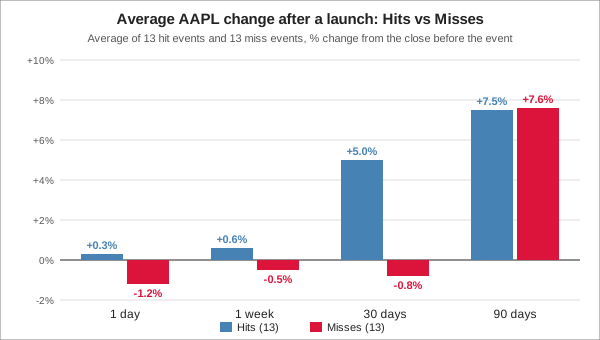
| Average change | 1 day | 1 week | 30 days | 90 days |
|---|---|---|---|---|
| 13 Hits | +0.3% | +0.6% | +5.0% | +7.5% |
| 13 Misses | -1.2% | -0.5% | -0.8% | +7.6% |
| Hits up after 30 days | 8 of 13 (62%) | |||
| Misses up after 30 days | 6 of 13 (46%) | |||
Hits are up about 5% after 30 trading days while misses are slightly down, so the product's reputation does show up in the stock. But keynote day itself is nearly flat either way, and by 90 days both groups average about +7.5%: a bad launch has hurt AAPL for about a month, not a quarter. The 30-day gap is also less clean than the averages suggest. Only 8 of 13 hits were actually higher after 30 days, compared with 6 of 13 misses, so the verdict is a tilt, not a rule.
2. Every event, ranked
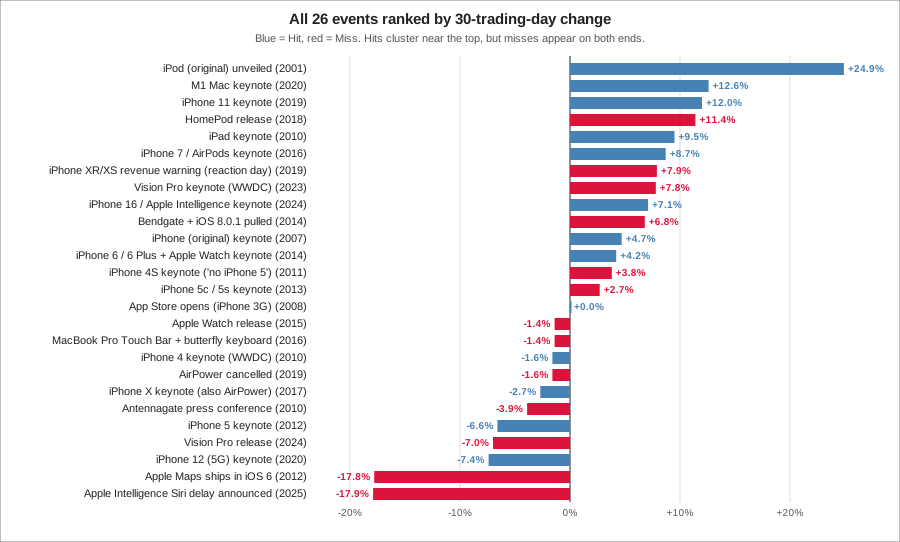
Sorting all 26 events shows why the averages need care. Hits are mostly in the top half, but three misses (HomePod, the 2019 revenue warning and the Vision Pro keynote) are in the top eight, and the bottom of the chart is a mix of both. The two worst 30-day results are both misses (the Siri delay and Apple Maps), and those two alone pull the miss average down by about 3 points.
3. Keynote vs. release day vs. crisis
| Event type | Events | 1 day | 1 week | 30 days | 90 days | Up after 30 days |
|---|---|---|---|---|---|---|
| Keynote (announced) | 16 | -0.2% | +0.1% | +4.9% | +12.9% | 11 of 16 |
| Release (shipped) | 5 | +0.4% | +1.0% | -3.0% | -13.2% | 1 of 5 |
| Crisis (public problem) | 5 | -2.4% | -1.2% | -1.7% | +11.3% | 2 of 5 |
Splitting by what kind of event it was tells a clearer story than Hit / Miss. Keynotes, where Apple announces something new, are followed by the strongest gains: +4.9% after 30 days and +12.9% after 90. Release days, when the product actually ships, are the opposite: only 1 of 5 was higher 30 days later, which fits the "sell the news" idea. Crises produce the worst first day (-2.4% on average, including the -10% revenue warning) but are up +11.3% a quarter later, so the market recovered from every Apple scandal in this list.
Caution: only 5 events are releases, and two of them (the App Store in 2008 and Apple Maps in 2012) happened right before big market-wide drops. Without those two, the other three releases average +1.0% after 30 days, so the release-day pattern is a hint, not a proven effect.
4. Outliers and outside events
Several of the biggest numbers in the dataset have more to do with the economy than with Apple's products. Click a highlighted sentence to find that event in the table below.
The App Store's -48.2% after 90 days is the 2008 financial crisis: the App Store opened in July 2008 and Lehman Brothers failed that September, taking the entire market down with it.
The iPhone 5 and Apple Maps events are one week apart in September 2012, when AAPL was at a record high. Both show a drop of more than 30% at 90 days, so Maps probably gets more blame than it deserves.
The 2019 revenue warning was the worst single day (-10.0%), yet the stock was up +19.5% three months later.
The Siri delay's -17.9% after 30 days runs into April 2025, when new tariff announcements sent the whole stock market down.
The original iPhone is the only launch with a big one-day jump (+8.3%), the one time the market clearly reacted to a product on the day.
RESET Click RESET to clear the table highlights.
| # | Product / Event | Event date | Verdict | 1 day | 30 days | 90 days |
|---|---|---|---|---|---|---|
| 2 | iPhone (original) keynote | Jan 9, 2007 | Hit | +8.3% | +4.7% | +28.7% |
| 3 | App Store opens (iPhone 3G) | Jul 10, 2008 | Hit | +1.4% | +0.0% | -48.2% |
| 8 | iPhone 5 keynote | Sep 12, 2012 | Hit | +1.4% | -6.6% | -31.8% |
| 9 | Apple Maps ships in iOS 6 | Sep 19, 2012 | Miss | +0.0% | -17.8% | -35.1% |
| 18 | iPhone XR/XS revenue warning (reaction day) | Jan 3, 2019 | Miss | -10.0% | +7.9% | +19.5% |
| 26 | Apple Intelligence Siri delay announced | Mar 7, 2025 | Miss | +1.6% | -17.9% | -10.8% |
5. Limits of this analysis
- Small sample. 26 events, 13 per group. One unusual quarter can move an average by several points.
- No market benchmark. The changes are raw AAPL moves. They are not compared to the S&P 500 over the same days, so crashes and rallies that hit every stock (2008, 2025) are counted as if they were Apple news. An "event study" that subtracts the market's move would be the next step (see Resources).
- Overlapping windows. Some events are close together (iPhone 5 and Maps, iPhone 6 and Bendgate), so their 30- and 90-day windows share most of the same days.
- Hindsight verdicts. Hit / Miss is decided years later, but investors on the day did not know how the product would sell.
Conclusion
Apple's stock does not react much to a product on the day it is announced. Over the next month, hits do better than misses by about 6 points on average, but by one quarter later that difference is gone. The more useful split is by event type: announcements were usually followed by gains, ship days were usually followed by small drops, and even Apple's worst public problems were forgotten within about three months.